The Milkweed Ballet performs the “Waltz of the Flowers.”
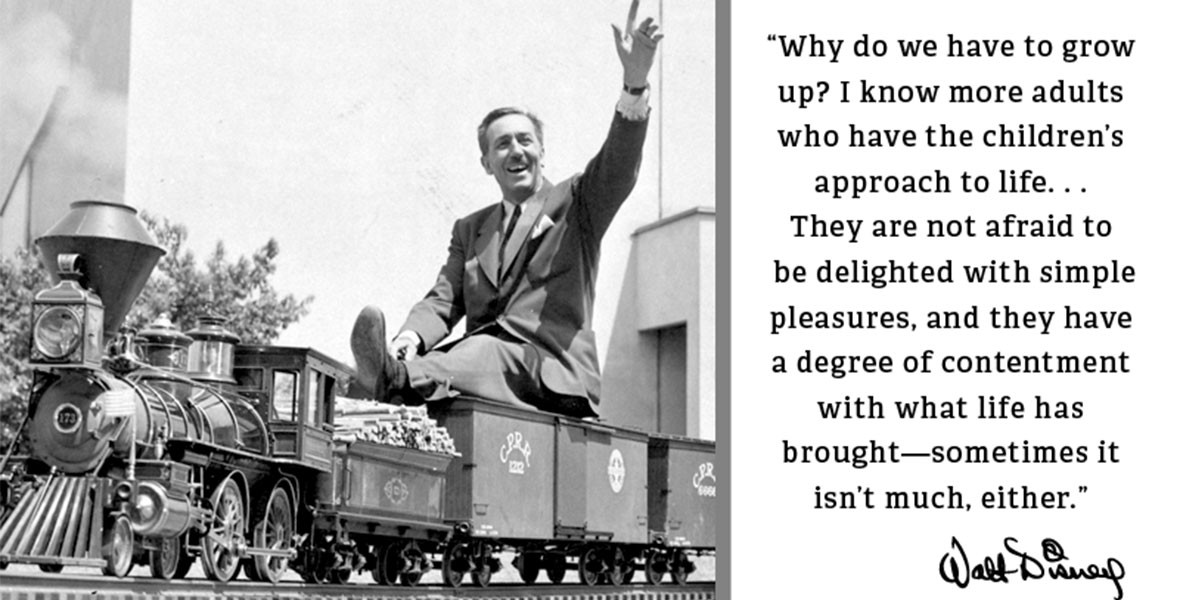
“I believe that Fantasia made a great contribution by opening the door to great music for those who had never really been exposed to it before.”—Walt Disney
The motion picture Fantasia is a film that can never be duplicated. Never again will conditions be ideal for the production of such a film. In the enlightened atmosphere of his Hyperion Studio, Walt Disney was able to bring together a team of extremely creative young artists and cast them in slots in a production where their particular strengths and aptitudes could be best utilized. He set no limits on their creative imaginations and enabled them to use their talents to the utmost in producing a film the likes of which had never been seen before. Fantasia has a timeless and universal charm, standing as one of the all-time classic motion pictures. By itself, it raised animation from the realm of the cartoon to a true art form, giving its viewers a unique motion picture experience, one of total involvement in both sight and sound.
The aim of Walt Disney and his staff was to create a motion picture capable of giving pleasure to all types and ages of people by appealing to their imagination, their love of beauty, and their sense of humor. Believing the concept that sound, formed into melodic and harmonious passages, elicits different emotions from different people, Disney drew upon the creativity of his animation staff. He wanted them to discover feelings and emotions in the sounds which would conjure up mental pictures of color and form that could be placed on paper. Music has something to say to everyone, and each person listens in his or her own way; music may very possibly and logically mean something different to every listener. Disney had no grand scheme of telling the world once and for all what composers really meant in their music; he only intended to show what a group of pieces of music meant to one select group of artists. It would be the same as the great Renaissance artists painting portraits of the Madonna; no two artists visualized her exactly the same so no two artists painted her in the same way.
The Disney artists steeped themselves in the music, then put on the screen the results of their imagination. None of the artists were musically trained, but they enjoyed and were challenged by it, and thus they arrived at startlingly original thoughts about the meaning of the orchestral score, thoughts that frequently were surprisingly in line with conventional musical theory. None of the artists worried about what the composer had in mind when he wrote the music. They merely told with their imaginations, pencils, paints, and brushes what the music meant to them. They worked on the premise that truly great music should stimulate the imagination of the listener; that noble, dramatic works should arouse like emotions, and light, amusing tunes should produce humorous reactions.
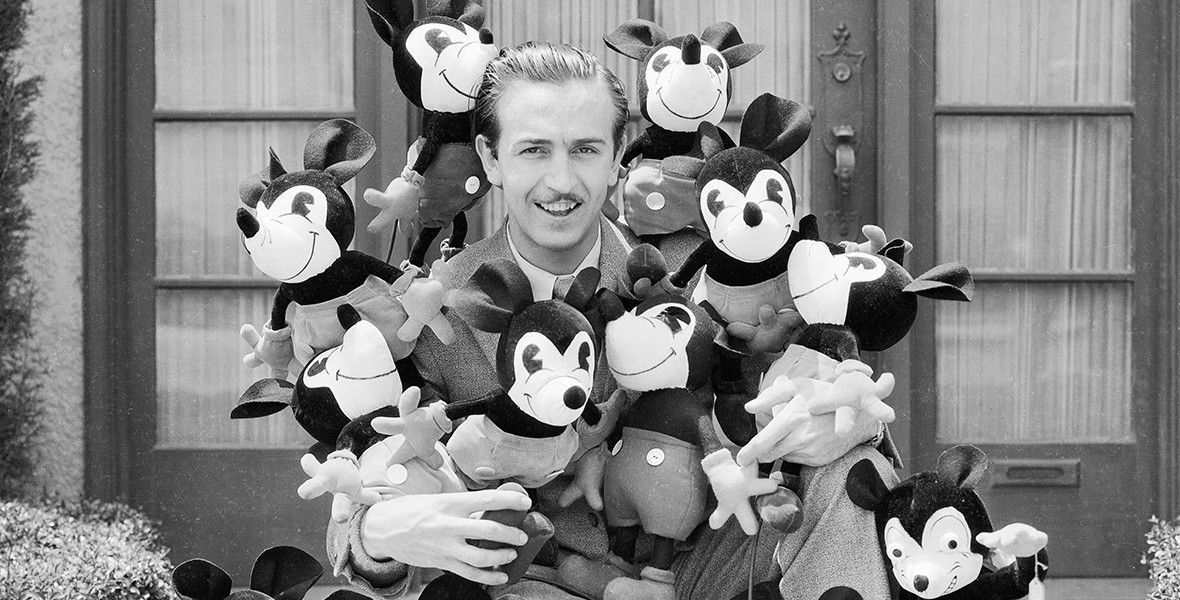
Fantasia was originally released in 1940. It had not been an immediate brainstorm in someone’s mind, but had had a long and involved history. From his earliest days as a producer of Mickey Mouse cartoons, Walt Disney had wanted to try something different from the wild and zany antics of Mickey and his gang. This led to his series of Silly Symphony cartoons.
The Silly Symphonies, including such classics as Three Little Pigs and The Tortoise and the Hare, were regarded by Walt Disney as mere stepping stones toward his first full-length animated feature, Snow White and the Seven Dwarfs, in 1937. Snow White set a standard of excellence, and Disney knew he could produce no more shorts based on music that did not measure up to its quality.
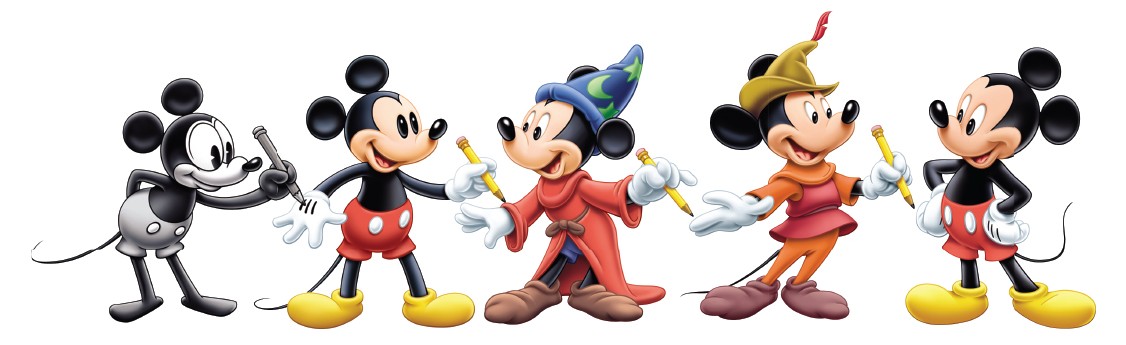
In departing from the pattern of the Silly Symphonies, Disney decided to select a piece of music that already had a story to it. There was no argument when Paul Dukas’ “The Sorcerer’s Apprentice” was suggested. Here would be the perfect piece of music for trying out the new premise. The music, telling the legend of the wayward apprentice who experimented with his mentor’s powers but discovered he could not handle them, lent itself to be used with animation.
To add prestige to the project, Walt Disney decided to use a well-known conductor. At a restaurant, he ran into Leopold Stokowski, conductor of the Philadelphia Orchestra since 1912, and Stokowski agreed to conduct “The Sorcerer’s Apprentice.” Stokowski had some very interesting ideas about instrumental coloring, which would be perfect for an animation medium.
Production began on the film, which was planned to star Mickey Mouse, but the costs mounted alarmingly fast. By the time it was finished, the cost was three to four times that of a normal Silly Symphony, and Disney came to realize that he would never get his expenses back if the film was released as a short. Disney’s thoughts turned to a full-length film. With the first suggestions to make a “Concert Feature,” as the working title would be, Stokowski was retained to help select the musical works to be included, and joining him to act as musical advisor was the noted music critic and composer, Deems Taylor.
Walt Disney did not claim to be a musician in any sense of the word. In fact, his faux pas regarding “Rite of Spring” has been often reported: When Stokowski suggested the piece under its French title, “Le Sacre du Printemps,” saying “How about the ‘Sacre,’” Walt Disney countered, “The Sock? What’s that?” Nevertheless, Stokowski commented that Disney was a natural musician by instinct. While working on Fantasia, Stokowski was constantly amazed at the reactions and impression, which Disney received from the music of the great masters. Together they studied hundreds of world-famous masterpieces, listening to recordings by the hour, arranging tentative programs and rearranging them, suggesting action that might be used to interpret the various pieces. Works were chosen which were very different in mood and tempo, each indicative of its creator’s musical genius. The premise was that the orchestra would be presenting an evening’s concert, interpreted on the screen by the artistry of Walt Disney and his staff. The pieces would be spaced in the program so that no two would conflict, so that a steady unfolding of entertainment would occur, and so that the audience would not be forced to take too many exhausting emotional impacts in large doses.
As the elements comprising the program slowly fell into place, it was a unanimous decision to open with Bach’s abstract “Toccata and Fugue in D Minor.” Other pieces were the beautiful “Nutcracker Suite,” the powerful “Rite of Spring,” a serene “Pastoral Symphony,” the humorous “Dance of the Hours,” and the juxtaposition of the sacred “Ave Maria” with the profane “Night on Bald Mountain.”
The completed Fantasia premiered on November 13, 1940 at the Broadway Theater in New York. While some critics faulted Walt Disney for trying to foist his visualizations of the musical pieces on theater audiences, others loved the novelty. Today, more than five decades after the first release of Fantasia, the picture is still going strong. Some reviewers stated that here was a film that was 30 years ahead of its time, and that has been proved true today. Fantasia is now given the respect it so highly deserves as one of America’s greatest cinematic classics.
Essay by Dave Smith, circa 1990.